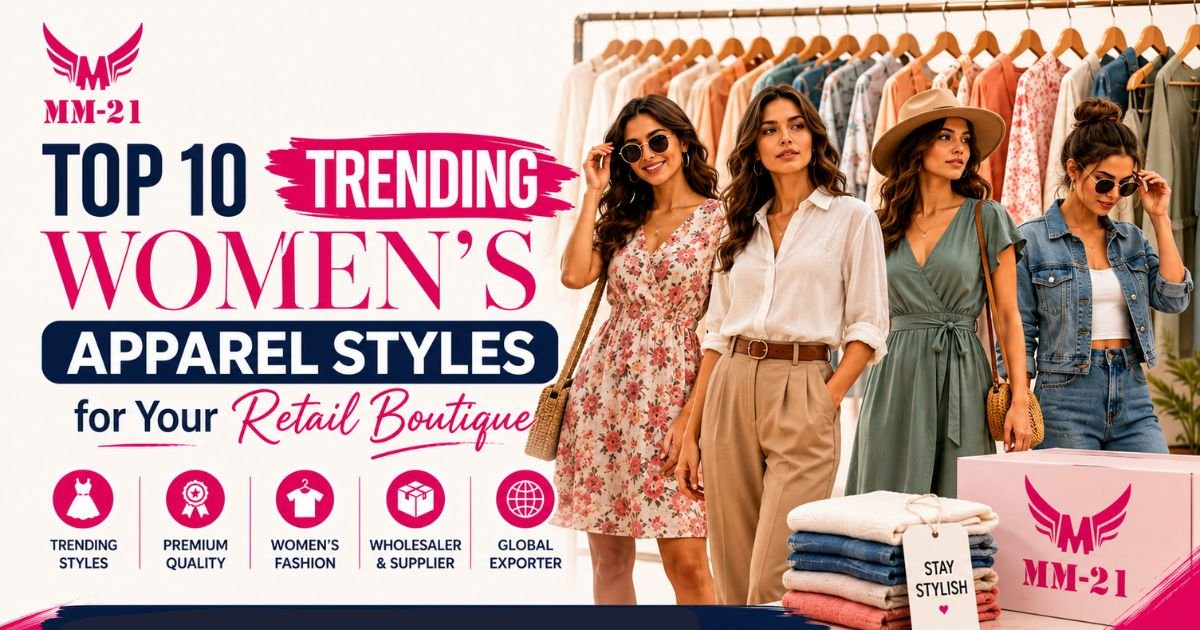
Staying ahead of trends is one of the most challenging parts of running a retail boutique. Buy too early and you carry dead stock. Buy too late and your competitors have already cleared the market. This guide covers the ten women’s apparel categories that are consistently performing well in retail, why each one is gaining traction, and how boutique owners can source them effectively from Indian wholesale markets.
What Drives Women’s Fashion Trends in India
India’s domestic fashion market is large, diverse and increasingly digitally influenced. Trends in women’s apparel are now shaped by a combination of social media content, influencer marketing, celebrity styling and shifting lifestyle preferences. Comfort, versatility and value for money are consistently ranked as the top purchase drivers across most consumer segments.
For wholesale fashion garments in India, this translates into strong demand for products that bridge the gap between casual and smart-casual dressing. Buyers stocking for Indian boutiques or for diaspora communities abroad often find that these crossover styles outperform purely occasion-wear or purely athleisure ranges.
Top 10 Women’s Apparel Categories
1. Women’s Jeans
Jeans remain the single most consistent category in women’s retail. From high-street to boutique, demand is stable year-round with seasonal variation in colour and wash preferences. Buyers looking to stock from a women’s jeans manufacturer should focus on core fits in neutral washes for carry-forward stock, supplemented by seasonal statement styles.
Key selling points: versatility, durability, a wide consumer age range, and a high repeat purchase rate.
2. Cargo Jeans
Cargo jeans have shifted from niche utility wear to mainstream fashion. The combination of practical pockets and relaxed silhouettes appeals strongly to the 18-35 demographic. Cargo-inspired styling is particularly popular on social media, making stock turnover faster for boutiques with an active online presence.
When sourcing from a women’s cargo jeans manufacturer, look for styles with contrast stitching, varied pocket configurations and fabric options that include both rigid denim and stretch blends.
3. Jeggings
Jeggings sit at the intersection of comfort and style and have maintained strong consumer demand since they entered mainstream retail. They perform particularly well as carry-forward basics and in plus-size ranges where comfort is a primary purchase driver.
A reliable women’s jeggings manufacturer should offer varying stretch percentages (typically 2% to 5% elastane content) across different weights and colour options to give your range depth.
4. Trousers
Women’s trousers have expanded well beyond formal office wear. Wide-leg, tailored, cropped and relaxed-fit trousers now serve a broad casual-to-smart market. This category has seen consistent growth as remote and hybrid working blurs the boundaries between comfort and professional dressing.
Sourcing from a dedicated women’s trousers manufacturer gives boutique owners access to a wider fit range than most generalist suppliers can offer, which is important for catering to different body types and customer segments.
5. Joggers
The activewear-to-streetwear crossover shows no sign of reversing. Women’s joggers are now worn not just for exercise but for travel, casual dining and everyday errands. This broadens their retail appeal considerably.
Women’s joggers manufacturer ranges typically include French terry, fleece-back and technical-jersey options. For boutiques, French terry and mid-weight fleece styles offer the widest seasonal coverage.
6. Jackets
Women’s jackets are high-margin, seasonal pieces that can anchor an entire seasonal range. Denim jackets and quilted styles lead in volume, while bomber, biker and structured blazer-jacket hybrids serve more fashion-forward consumers.
The women’s jacket manufacturer segment in India has invested significantly in finishing quality and construction detail over recent years, making Indian-manufactured jackets increasingly competitive against alternatives from Bangladesh or China.
7. Capri Jeans
Capri jeans remain a strong seller in markets with warm climates or extended summer seasons. They appeal to consumers who want the look of jeans without full-length coverage and perform well in coastal, resort and subtropical retail environments.
Working with a specialist women’s Capri jeans manufacturer allows buyers to access a range of cut lengths, fabric weights and embellishment options that generalist manufacturers may not carry.
8. Wide Leg Denim
Wide-leg denim has been one of the strongest denim trend movements of recent years. The silhouette flatters a wide range of body shapes and pairs well with both fitted tops and oversized styling. High-rise wide-leg styles in particular have driven significant volume in boutique retail.
When sourcing wide-leg styles, pay close attention to the seat and thigh measurements. Poorly proportioned wide-leg cuts are a common fit complaint, so sample review is essential before placing a production order.
9. Straight Fit Denim
Straight-fit denim has the broadest consumer appeal across age groups. It is classic enough for conservative buyers, versatile enough for fashion-forward styling, and consistent in its year-round sell-through. Any boutique with a women’s denim range needs strong, straight-fit representation.
Look for straight-fit options across light, mid and dark washes, as each serves a distinct usage occasion for the consumer.
10. Casual Everyday Wear
The broadest category on this list is also one of the most commercially important. Casual everyday wear, including relaxed-fit co-ords, knit sets, printed shirts and easy-wear bottoms, drives consistent footfall in boutiques because consumers buy these items frequently and without much deliberation.
For this category, responsiveness to trends is key. Smaller, more frequent orders aligned with seasonal colour stories tend to outperform large one-time buys.
Category Comparison at a Glance
| Category | Season | Trend Longevity | Boutique Priority |
| Women’s Jeans | Year-round | Perennial | Core |
| Cargo Jeans | Spring / Summer | 3-5 seasons | High |
| Jeggings | Year-round | Perennial | Core |
| Trousers | Year-round | Perennial | Core |
| Joggers | Autumn / Winter | 3-4 seasons | High |
| Jackets | Autumn / Winter | Seasonal cycle | High margin |
| Capri Jeans | Spring / Summer | Perennial in warm climates | Regional |
| Wide Leg Denim | Year-round | Current peak | High |
| Straight Fit Denim | Year-round | Perennial | Core |
| Casual Everyday Wear | Year-round | Trend-driven | Frequent refresh |
How Retailers Can Select Trend-Based Inventory
Trend selection does not have to be guesswork. Experienced boutique buyers use a combination of data sources and qualitative signals to make better stocking decisions.
- Monitor social media platforms for emerging silhouette and colour trends, particularly in the 18-35 demographic
- Review your own sell-through data by category and identify which styles cleared within 30 days vs. which required promotion
- Talk directly to your customers about what they have been trying to find and could not
- Track what wholesale women’s clothing manufacturer ranges are offering as their hero styles for the upcoming season
- Attend buying fairs and wholesale expos where possible to see quality and construction first-hand
The goal is to build a range that has a core of perennial styles generating consistent revenue, supported by a smaller allocation of trend-led pieces that drive newness and social media engagement.
Stock Planning Tips for Boutique Owners
Even with the right product selection, poor stock planning can undermine profitability. Here are the principles that experienced boutique buyers apply.
Maintain a Core-Fashion Split
Allocate roughly 60-70% of your buying budget to core, repeat-purchase styles and 30-40% to trend-led pieces. This ratio ensures consistent cash flow while still creating the newness that attracts footfall.
Order in Smaller, More Frequent Batches
Rather than one large seasonal order, consider two or three smaller orders spaced across the season. This reduces end-of-season clearance risk and allows you to reorder styles that are performing better than expected.
Track Sell-Through Weekly
Identify within the first two to three weeks of a style hitting the floor whether it is performing at or above expectations. Fast-selling styles should trigger a reorder conversation with your women’s clothing supplier before stock runs out.
Build Supplier Relationships for Faster Turnaround
Boutique owners who maintain consistent relationships with ladies’ garments manufacturers in India often negotiate faster turnaround on reorders. A supplier who knows you, trusts your payment history and values your business is more likely to prioritise your reorder during a busy production period.
Plan Your Size Depth
Avoid over-buying in extreme sizes at the expense of mid-range sizes that typically sell most quickly. Review your size sales data from previous seasons to calibrate your size ratio accurately.
Frequently Asked Questions
1. Which women’s apparel category has the best margins for boutique retailers?
Jackets and outerwear typically offer the highest margin potential in women’s retail, often 60-80% above cost for fashion-led styles. Denim also offers strong margins when sourced directly from a wholesale women’s clothing manufacturer rather than through distributors.
2. How many styles should a small boutique stock per category?
For a small boutique, two to four styles per core category is a practical starting point. This provides enough variety for the customer to feel there is a genuine range without fragmenting stock depth across too many options.
3. How often should boutique owners refresh their women’s clothing range?
Most successful boutiques refresh their range at least four to six times per year, aligned with seasonal shifts. Core basics are replaced as needed, while trend-led pieces are introduced in smaller deliveries every six to eight weeks.
4. What is the advantage of sourcing women’s apparel directly from Indian manufacturers?
Direct sourcing from Indian women’s apparel manufacturers eliminates distributor markups, gives buyers direct quality control, allows for customisation and provides better pricing at volume. It also enables faster resolution of any quality or delivery issues.
5. Can boutique owners get exclusive styles from wholesale suppliers in India?
Yes, many bulk women’s clothing suppliers in India offer exclusivity arrangements for specific styles or colourways, particularly for buyers placing consistent orders above a certain volume threshold. This is worth negotiating when you have an established relationship with a supplier.
Final Thoughts
Building a successful women’s boutique range requires balancing the stability of core perennial styles with the excitement of trend-led pieces. The ten categories covered in this guide represent the most commercially reliable options available to boutique buyers today.
Sourcing from India gives retailers access to a deep manufacturing base, competitive pricing and an increasingly sophisticated approach to trend-led design. Whether you are stocking jeans, cargos, jeggings or jackets, the combination of product quality and supplier flexibility available through Indian wholesale markets is difficult to match elsewhere.
The key is to plan your range thoughtfully, build supplier relationships based on trust and consistency, and use data to refine your stocking decisions season by season.
Start Building Your Boutique Range
Mala Merchant is a trusted women’s clothing manufacturer offering wholesale women’s apparel across jeans, cargo jeans, jeggings, trousers, joggers, jackets and capris.
Contact the team to request a catalogue, samples or a bulk pricing quote tailored to your boutique requirements.